

Quick answer
The Norwood Scale (properly the Hamilton-Norwood scale) is the most widely used way of grading male pattern baldness. It runs from stage 1, a normal or barely receding hairline, to stage 7, where only a horseshoe of hair remains around the sides and back of the head. Doctors use it to describe how far hair loss has progressed and to help plan treatment, but it is a guide rather than an exact measurement, and not every man passes through every stage.
What is the Norwood Scale?
Male pattern baldness, also called androgenetic alopecia, is the most common type of hair loss in men. It affects about 30% of men by around the age of 30 and about 50% by the age of 50, and it tends to become more common with age.
The scale was first drawn up by the dermatologist James Hamilton in 1951. The surgeon O'Tar Norwood revised it in 1975, and the combined Hamilton-Norwood version is the one still used in clinics and research today.
It works as a set of reference pictures. Each stage shows a typical pattern of recession at the temples and thinning on the crown (the top and back of the head, also called the vertex). You compare your own hair with the pictures to see which stage it most resembles.
What are the 7 stages of the Norwood Scale?
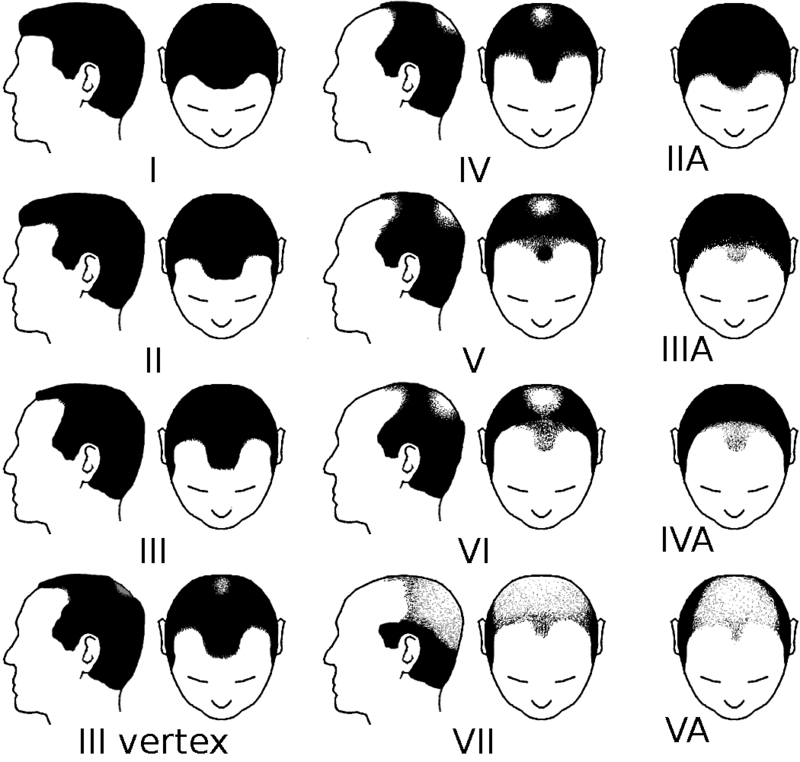
Diagram: Keministi, Wikimedia Commons (CC0)
Stage 1: no significant hair loss
The hairline sits in its natural position with little or no recession. This is the baseline for comparison.
Stage 2: slight recession at the temples
The hairline begins to move back a little at both temples, usually evenly on each side, giving a slight triangular or "M" outline. Many men at this stage are simply seeing their hairline mature, which is normal from the late teens onwards. Our guide to receding versus maturing hairlines explains the difference.
Stage 3: noticeable recession
The temples recede further, leaving little or no hair in those areas and a deeper "M" shape. This is the first stage where the hair loss is generally regarded as significant.
Stage 3 vertex: some men keep a stage 3 hairline at the front but lose hair mainly on the crown. This variant is recorded separately as "3 vertex".
Stage 4: recession plus a thinning crown
The front recedes further than in stage 3 and there is clear thinning or a bald patch on the crown. A band of hair across the top of the head still separates the two areas.
Stage 5: the areas get larger
Both the frontal recession and the crown patch are bigger, and the band of hair between them becomes narrower and thinner.
Stage 6: the areas join
The band between the front and crown has thinned so much, or disappeared altogether, that the two bald areas merge into one.
Stage 7: the most advanced pattern
Only a narrow horseshoe-shaped band of hair remains around the sides and back of the head. This band is often thin too.
What does "type A" mean?
Stages 3 to 5 can also carry the letter A. In type A hair loss, the hairline moves back from the front as a whole, rather than forming an "M", and the crown is not involved in the same way. It is less common but is useful to recognise, because it affects how a hairline might be restored.
How accurate is the Norwood Scale?
It is useful but imperfect. In one study, 23 raters, including experienced dermatologists, classified the same set of photographs, and the researchers concluded that the scale's reliability was unsatisfactory even in expert hands. Two people can look at the same head and pick neighbouring stages.
So treat your own self-assessment as a rough guide. A clinician examining your scalp in person, and looking at the density of hair in the donor area at the back and sides, will give a much more reliable picture.
How quickly do you move through the stages?
There is no fixed timetable. The British Association of Dermatologists describes male pattern hair loss as usually progressing very slowly, over years or decades. Some men stay at stage 2 or 3 for life, while others progress to stage 6 or 7.
Your family history, the age you started losing hair and your individual sensitivity to hormones all play a part. Hair loss that starts early, in the late teens or early twenties, is often a sign that it may progress further, which matters if you are thinking about a transplant (see below).
What causes male pattern baldness?
Male pattern baldness is caused by a combination of genes and hormones. The key hormone is dihydrotestosterone (DHT), which the body makes from testosterone. In men who are genetically susceptible, DHT makes the hair follicles on the top and front of the scalp gradually shrink. The hairs they produce become finer, shorter and lighter, until eventually some follicles stop producing visible hair.
Research has linked more than 190 genes to this kind of hair loss, and it often runs in families. The hair at the back and sides of the head is usually far less affected by DHT, which is why that area is used as the donor area in a hair transplant.
For more detail, read our guide to what DHT is and how it causes hair loss.
Can male pattern baldness be prevented?
No. There is no cure and no proven way to prevent it if you are genetically prone to it. Treatments can slow it down or partly reverse it for some men, but only while they are used.
Healthy habits are good for you, but they will not stop male pattern baldness on their own. They matter more for other, often temporary, types of hair loss. The NHS lists stress, illness, weight loss and iron deficiency among the causes of temporary hair loss, and these can happen alongside male pattern baldness and make it look worse.
- Diet: a balanced diet with enough protein and iron supports general hair health. See our article on nutritional and vitamin deficiencies that can cause or worsen hair loss.
- Stress: stress can trigger a separate, temporary shedding. Our guide on hair loss from stress explains more.
- Smoking: a study of 740 men in Taiwan found that smokers were more likely to have moderate or severe male pattern hair loss, with the link stronger in heavier smokers. This shows an association rather than proof that smoking causes baldness, but it is one more reason to stop.
If your hair loss is sudden, patchy, or comes with an itchy, sore or scaly scalp, see your GP, as that is not typical of male pattern baldness.
How is male pattern baldness treated?
No treatment works for everyone, and the NHS advises seeing a GP about your hair loss before going to a private clinic. The main options are below.
Topical minoxidil
Minoxidil is a lotion or foam applied to the scalp. The 5% strength for men is available from pharmacies without a prescription. It needs to be used for at least 6 months, and possibly up to 12 months, before any benefit can be judged, and the benefit only lasts while you keep using it. Side effects can include dryness, redness, scaling and itching of the scalp, and some people notice extra shedding for a few weeks after starting.
Oral minoxidil
Oral minoxidil, taken as a low-dose tablet, is prescription-only and is used for hair loss outside its original licence, so it needs a doctor's assessment first. Side effects, which depend on the dose, can include fluid retention, a faster heart rate, dizziness and unwanted hair growth on the face and body.
Finasteride
Finasteride is a prescription-only tablet that lowers DHT levels. It can take up to 14 months to show a benefit, and hair loss resumes if it is stopped. It is not available without a doctor's or prescriber's assessment.
It has important side effects. The British Association of Dermatologists reports reduced sex drive and erection problems in about 2% of men. In May 2026 the MHRA, the UK medicines regulator, strengthened its warnings on finasteride: it can cause depression, suicidal thoughts and sexual dysfunction, and these effects may persist after treatment stops. Anyone taking finasteride 1mg who develops depression or suicidal thoughts should stop it immediately and contact their doctor. Whether it is suitable for you is a decision for a prescriber after a proper assessment.
Hair transplant
A hair transplant moves hair follicles from the donor area at the back and sides of the head to the thinning or bald areas. Hair transplants are cosmetic and are not offered on the NHS.
There are two main techniques, and FUE Clinics offers both:
- FUE (follicular unit extraction): individual follicles are removed one at a time with a small punch. It leaves tiny dot scars scattered across the donor area, which are usually hard to see once the hair grows.
- FUT (follicular unit transplantation): a strip of scalp is taken from the donor area and divided into follicular units under a microscope. It leaves a single linear scar, normally hidden by the surrounding hair.
A transplant does not stop male pattern baldness. The transplanted hair comes from DHT-resistant donor hair and generally keeps growing, but the native hair around it can carry on thinning. That is why a good surgeon plans for the future pattern of your hair loss, not just how it looks today. Results vary from person to person, and risks include bleeding, infection, scarring and some grafts not taking.
At what Norwood stage can you get a hair transplant?
There is no single "right" stage, and the Norwood number alone does not decide it. What matters most is:
- Your age and how settled your hair loss is. A review of pre-surgical considerations notes that some authors suggest waiting until men are at least 25 to 30 and/or at Norwood stage 3 to 4 before a first transplant. Operating too early risks the surrounding hair continuing to recede, leaving the transplant looking isolated.
- Your donor supply. The number of grafts available at the back and sides is limited. At stages 6 and 7 there may not be enough donor hair to cover the whole area, so treatment tends to focus on framing the face and building density where it matters most.
- Your goals. Restoring a hairline at stage 3 is a very different job from covering the crown at stage 5.
- Medical treatment alongside surgery. Because hair loss usually continues, surgeons often discuss whether medical treatment is appropriate as well. Any prescription medicine needs a doctor's assessment first.
In short, men at stages 3 to 5 are often good candidates, men at stage 2 may be advised to wait, and men at stages 6 and 7 may still benefit but with more limited coverage. A consultation is the only way to find out what is realistic for you.
How FUE Clinics can help
Whatever stage you think you are at, a free consultation will give you an honest assessment of your hair loss, your donor area and whether a transplant is likely to help. FUE Clinics is a CQC-registered UK clinic and all surgery is carried out in the UK by our surgical team: Miss Anne Kremer, Dr Peter Williams and Dr Richard Clarke. You can meet the team. Free assessments are also available by video.
Hair transplants at FUE Clinics start from £1,500 and go up to £6,750 depending on the number of grafts, with 12 months 0% finance available. See our hair transplant cost and finance pages. If you are not ready for surgery, a trichologist consultation can help you understand your hair loss first.
To book, contact us or call 0330 363 0001.
Frequently asked questions
What Norwood stage am I? Compare your hairline and crown with the stage pictures above, ideally using photos taken from the front, top and back in good light. Because even experts can disagree by a stage, an in-person assessment is more reliable.
Is Norwood 2 balding? Not necessarily. Slight, even recession at the temples is common and can simply be a maturing hairline, so many men at stage 2 never progress much further.
Can you go back down the Norwood Scale? Medical treatment can slow hair loss and regrow some hair in some men, but only while it is used. A hair transplant can restore coverage, but it does not change the underlying pattern of loss in your native hair.
Is Norwood 7 too late for a hair transplant? Not always, but donor hair is limited at stage 7, so full coverage is usually not possible. A surgeon will assess your donor area and discuss what a realistic result would look like.
How long does it take to go from Norwood 2 to Norwood 7? There is no set timescale and many men never reach stage 7. Progression is usually slow, over years or decades, and depends largely on your genes.
Does the Norwood Scale apply to women? No. Women's hair loss usually follows a different pattern, with thinning over the top of the head and the hairline often kept, and is graded on a different scale. See our page on hair transplants for women.
Sources
- NHS, Hair loss: https://www.nhs.uk/conditions/hair-loss/
- NHS, Hair transplant: https://www.nhs.uk/tests-and-treatments/cosmetic-procedures/cosmetic-surgery/hair-transplant/
- British Association of Dermatologists, Hair loss male pattern (androgenetic alopecia), patient information leaflet: https://www.bad.org.uk/pils/hair-loss-male-pattern-androgenetic-alopecia
- MHRA Drug Safety Update, Finasteride and dutasteride: updated safety warnings for psychiatric side effects and sexual dysfunction (11 May 2026): https://www.gov.uk/drug-safety-update/finasteride-and-dutasteride-updated-safety-warnings-for-psychiatric-side-effects-and-sexual-dysfunction
- Primary Care Dermatology Society, Male pattern alopecia and female pattern alopecia: https://www.pcds.org.uk/clinical-guidance/alopecia-male-and-female-pattern-alopecia
- Cortez GL, Hassun K, Linhares LRP, et al. Male androgenetic alopecia. An Bras Dermatol. 2025;100(2):308-321: https://pmc.ncbi.nlm.nih.gov/articles/PMC11962920/
- Guarrera M, Cardo P, Arrigo P, Rebora A. Reliability of Hamilton-Norwood classification. Int J Trichology. 2009: https://pmc.ncbi.nlm.nih.gov/articles/PMC2938573/
- Tan M, Yong AA, Wang ECE. Hair restoration surgery: pre-surgical considerations and pitfalls. Plast Aesthet Res. 2024;11:30: https://www.oaepublish.com/articles/2347-9264.2023.138
- Su LH, Chen TH. Association of androgenetic alopecia with smoking and its prevalence among Asian men: a community-based survey. Arch Dermatol. 2007: https://jamanetwork.com/journals/jamadermatology/fullarticle/654456
